Join the God Wins Newsletter
Christian news, commentary and Gospel outreach delivered directly to your inbox.
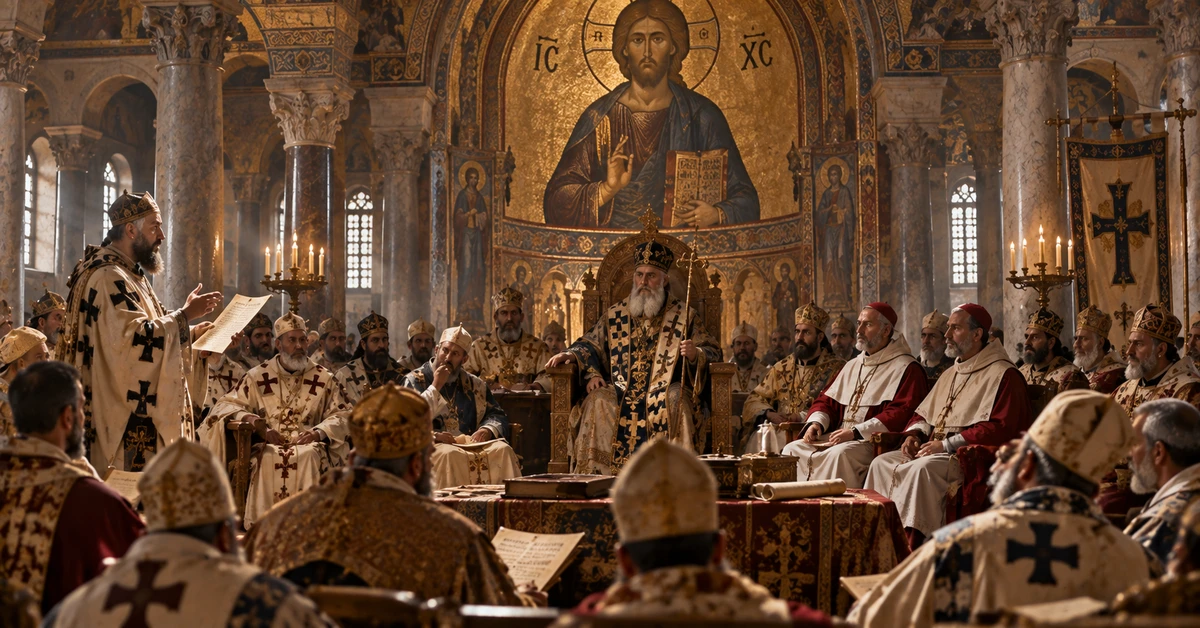
On 24 September 787, bishops gathered at Nicaea for the opening of the Second Council of Nicaea, beginning a meeting that would address one of the most divisive controversies in the Byzantine Church: the use of sacred images.
It was not the first attempt to hold the council. A council had originally been summoned in Constantinople in 786, but iconoclast soldiers entered the meeting and forced it to collapse. Empress Irene’s government subsequently removed the hostile military element from the capital, allowing the council to be reconvened at Nicaea, in present-day İznik, Turkey.
Patriarch Tarasios of Constantinople presided over the proceedings, with papal legates representing Pope Hadrian I among those attending. At the centre of their deliberations was the controversy over iconoclasm and whether sacred images of Christ and the saints should be destroyed or could legitimately be honoured within Christian worship and devotion.
The dispute was about considerably more than religious artwork. Christians had lived through decades in which imperial policy determined what could appear inside churches, images were destroyed and supporters of icons were punished. The controversy therefore brought questions of theology and worship into direct contact with the exercise of political power.
One of the fundamental theological questions was whether honour shown towards a sacred image necessarily amounted to worship of the image itself. The council ultimately rejected iconoclasm and distinguished between the veneration or honour shown to sacred images and the worship or adoration held to be due to God alone.
The Second Council of Nicaea is recognised by the Roman Catholic and Eastern Orthodox churches as the Seventh Ecumenical Council. Its historical significance extends beyond those traditions because the controversy touched on the Incarnation, Christian art, political authority and the visible expression of Christian faith.
The circumstances surrounding the council also demonstrated how closely political and religious authority could become intertwined in the Byzantine world. Just a year earlier, military intervention had prevented the bishops from carrying out the council at all. On 24 September 787, they assembled again in Nicaea and resumed the debate.
The council that followed rejected the destruction of sacred images while drawing a distinction between honouring them and offering the worship Christians held to be due to God alone. More than 1,200 years later, the underlying question remains recognisable: how can material things point towards God without themselves becoming idols?
Sources
- Second Council of Nicaea — historical text and introduction
- Catholic Encyclopedia / New Advent — Second Council of Nicaea
- Anglican Church in Europe — Nicaea 325
Join the God Wins Newsletter
Christian news, commentary and Gospel outreach delivered directly to your inbox.