A government can embrace Christian symbols while restricting Christian freedom. Russia is providing a disturbing example.
Russia has not banned the Bible.
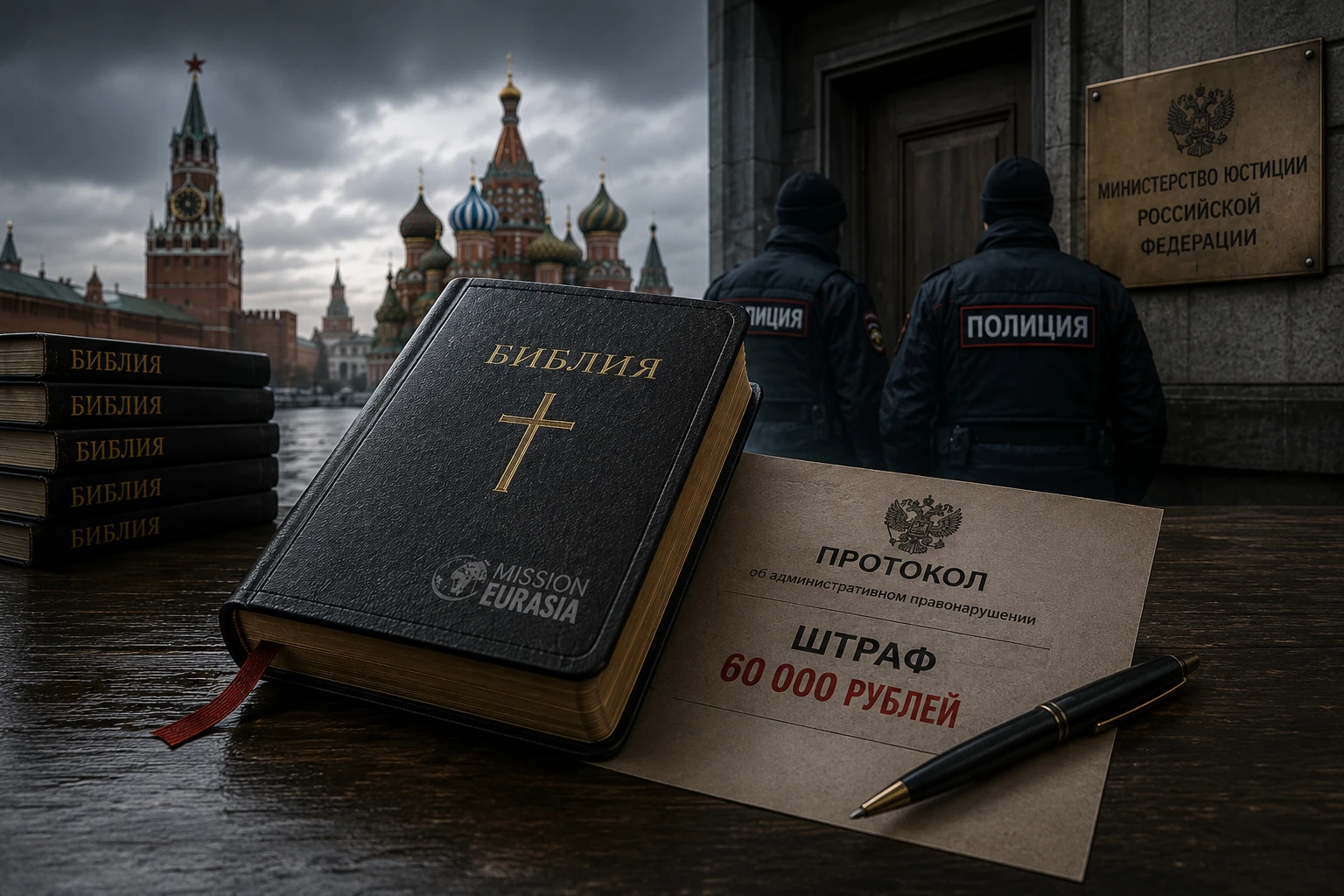
But Russian Christians can now face punishment for possessing entirely ordinary copies of Scripture because of the Christian organisation that printed them.
In May, Russian authorities designated the US-based evangelical ministry Mission Eurasia an “undesirable organisation”. The ministry has worked across the former Soviet Union since 1991, training Christian leaders and distributing Bibles and other Christian literature.
The consequences of that designation are now becoming clearer.
Russian authorities have reportedly been visiting churches, seminaries and other Christian institutions looking for material connected with Mission Eurasia.
Among the prohibited material they have found are Russian-language Bibles bearing the Mission Eurasia logo.
A Bible becomes evidence
Mission Eurasia was placed on Russia’s list of “undesirable organisations” on 13 May 2026.
Russian law does not merely prevent organisations on that list from operating freely. Individuals and institutions can also face administrative or criminal consequences for involvement with them or for distributing their material.
That distinction matters enormously in this case because some of the material being treated as prohibited is not political propaganda.
It is Scripture.
Christianity Today reported that Baptist pastor Peter Mitskevich was fined after authorities found Christian literature produced by Mission Eurasia, including Bibles.
Mitskevich is a prominent Russian evangelical leader. His case illustrates how a law directed formally at an organisation can reach directly into the ordinary religious life of a Christian congregation.
A Christian university was fined too
The pressure has not been limited to one pastor.
St Petersburg Christian University was reportedly fined 60,000 rubles after authorities discovered books associated with Mission Eurasia.
Once again, the central issue was not that officials had uncovered instructions for violence, espionage or political subversion.
The material was Christian literature.
That creates a disturbing legal reality for churches, seminaries and individual believers.
Books that were lawful to obtain and possess can suddenly become legally dangerous because the organisation that supplied them has subsequently been prohibited.
For Christian ministries that have spent decades distributing Bibles throughout the former Soviet Union, the consequences can reach far beyond current organisational activity.
Copies of Scripture already sitting on church shelves can effectively become liabilities.
The crackdown is broader than Mission Eurasia
Mission Eurasia is not the only evangelical organisation affected.
In July, Russian authorities also added Child Evangelism Fellowship to the undesirable-organisations list.
The ministry is an international evangelical organisation focused primarily on teaching Christianity to children.
These cases deserve attention because they reveal the breadth of the power being exercised.
A government does not need formally to announce that Christianity is illegal in order seriously to restrict Christian freedom.
It can instead determine which Christian organisations may function, which Christian literature may circulate and which relationships with believers outside the country are legally acceptable.
Russia’s complicated relationship with Christianity
Russia publicly presents itself as a defender of traditional Christianity.
Orthodox imagery, religious ceremony and appeals to Christian civilisation occupy a visible place in Russian public life.
That can create a misleading impression that religious liberty naturally follows.
It does not.
There is an important difference between a state honouring Christianity and a state allowing Christians to live freely according to conscience.
A government may value Christianity as part of national identity while simultaneously restricting Christians whose organisations, loyalties or relationships lie outside structures the state considers acceptable.
Christians cannot surrender conscience to the state
The New Testament does not teach Christians to seek needless conflict with government.
Christians are repeatedly instructed to respect lawful authority, pray for rulers and live peaceably.
But Scripture also establishes a boundary that no government may legitimately cross.
When the apostles were ordered to stop teaching in the name of Jesus, Peter and the other apostles answered:
That principle is essential to genuine Christian liberty.
The state may punish crime. It may protect public order. It may prosecute violence and genuine wrongdoing.
But it should not decide that an ordinary Bible becomes dangerous because of which evangelical ministry printed it.
Nor should possession of Christian literature become evidence against a pastor simply because the organisation that produced it has fallen out of favour with the government.
Why this matters beyond Russia
Christians should resist the temptation to judge religious-freedom questions according to whether they approve of the government involved.
The principle has to be consistent.
Christians in the West rightly object when believers are punished for preaching, evangelism or living according to conscience.
The same concern should apply when evangelical Christians face restrictions in a country that publicly associates itself with Christianity.
Political sympathy cannot determine the boundaries of religious liberty.
Neither can geopolitical allegiance.
The Church belongs to Christ.
Its freedom to preach the Gospel, distribute Scripture, teach children and maintain fellowship with other Christians should not depend upon whether a government finds a particular ministry politically convenient.
Pray for Russia’s Christians
Christians should pray for pastors and congregations navigating these restrictions.
Pray for wisdom for church leaders deciding how to respond.
Pray for believers who may find themselves questioned or punished because of Christian books already in their possession.
Pray also for those in authority, that they would recognise the difference between genuine threats to public safety and peaceful Christian ministry.
And pray that Russian Christians remain faithful to Christ even when obedience becomes costly.
Because the true measure of a government’s attitude towards Christianity is not whether it embraces Christianity when Christianity serves the state.
It is whether Christians remain free when their ultimate loyalty is to God rather than government.