
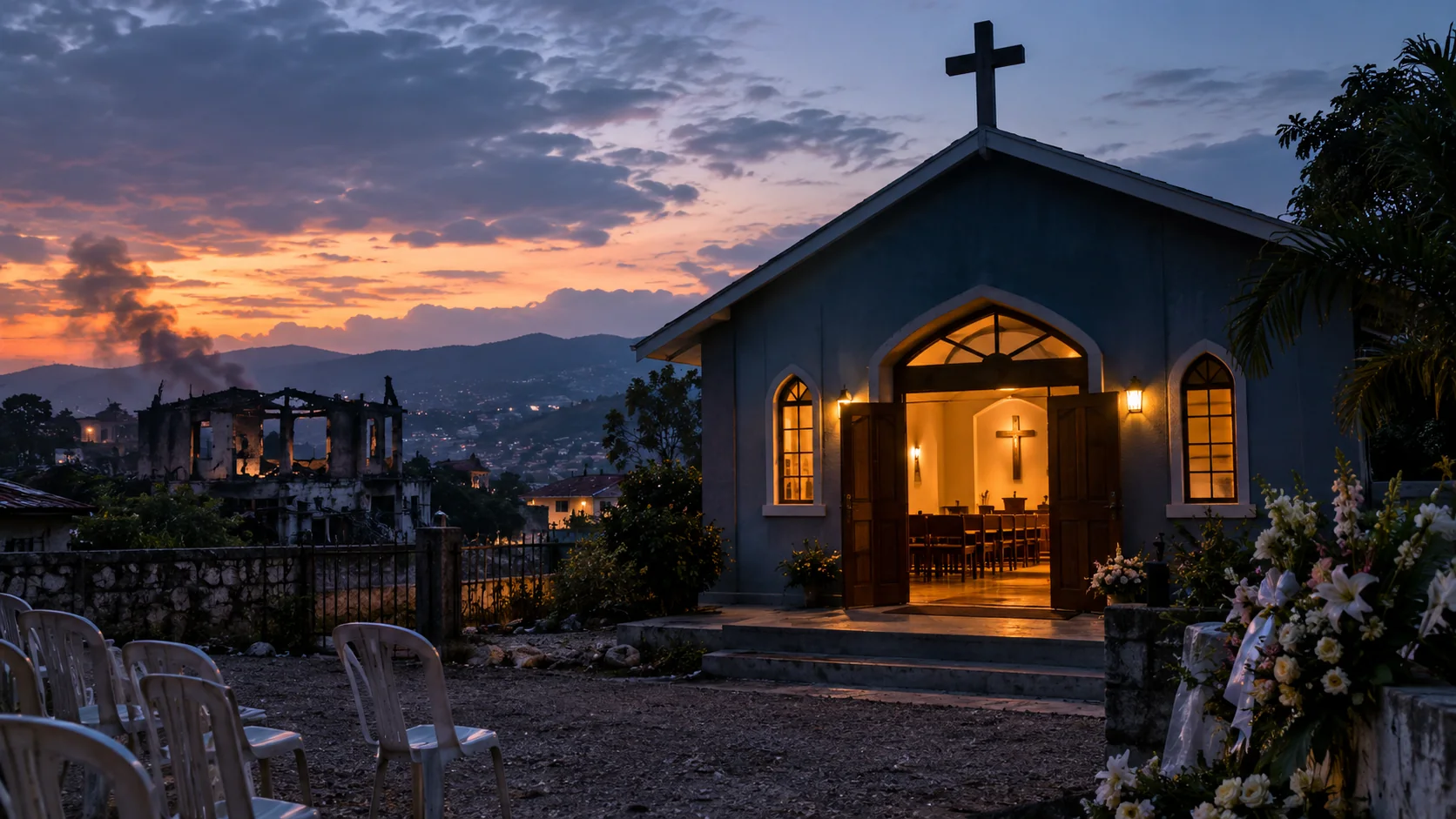
Hundreds of mourners gathered in Kenscoff, Haiti, on Sunday to bury victims of a massacre that killed at least 47 people. More than 50 residents had fled to a Protestant church for safety. According to the United Nations, gang members followed them and executed 34 around the church grounds.
Inside the funeral service, Gospel music filled the church as families grieved. Four coffins were carried in: a mother, a father, their son, and a 70-year-old man whose body had been burned during the attack.
They were four victims of an overnight assault that began on 23 August and became one of Haiti’s worst recent episodes of gang violence.
But one detail captures the collapse of security more starkly than any statistic.
More than 50 people ran to a Protestant church because they believed it might offer sanctuary.
The gunmen followed them.
A night of terror in Kenscoff
The United Nations says approximately 150 heavily armed gang members stormed several areas near central Kenscoff, a mountainous community overlooking Port-au-Prince.
Attackers opened fire on residents attempting to flee through the streets, killing at least 13.
Others reached the Protestant church.
According to the UN Human Rights Office, the attackers pursued more than 50 people who had sought refuge there. They forced them from the church premises, executed 22 in the courtyard and another 12 behind the church.
By the time the attack was over, the UN had verified at least 47 deaths, including three boys and two girls. Another 22 people were wounded and more than 52 abducted.
Children taken hostage
The violence did not end with the killings.
As the attackers withdrew, dozens of civilians were abducted. The UN later reported that a recording circulated on social media in which the gang threatened to kill captives if security operations against it continued.
Days later came a rare piece of good news.
UNICEF announced that six children and seven women abducted in Kenscoff had been released. The children included three under the age of two, a seven-year-old and two teenage girls. UNICEF and community leaders supported the efforts that contributed to their release.
Other captives remained a source of grave concern, and UNICEF called for any children still being held to be released immediately.
A country losing control
Kenscoff is not an isolated tragedy.
Haiti is living through a profound collapse of public order. Armed groups control large parts of Port-au-Prince and have expanded their influence beyond the capital. Nearly 1.5 million people have been internally displaced by violence.
Reuters reported that more than 3,000 people were killed in the first half of 2026 alone. Kenscoff itself has suffered repeated attacks since 2025, despite periods in which authorities said security had improved.
The coalition linked to the latest violence, Viv Ansanm, has been designated a foreign terrorist organisation by the United States.
Yet behind the language of gangs, terrorism, statistics and state failure are families who still have to live ordinary lives.
They still raise children. They still work. They still worship. They still bury their dead.
They ran to a church
There is an important distinction to make about what happened.
There is presently insufficient evidence that the 34 people killed around the church were murdered because they were Christians.
Nor should this massacre be presented as established anti-Christian persecution.
God Wins Ministries will not manufacture religious persecution where the evidence does not establish it.
The available reporting indicates that civilians entered the church because they were fleeing armed men and believed it offered somewhere safer than the streets.
That does not make the church irrelevant to the story.
It changes what the church represents.
For centuries, churches have been places to which frightened people have fled during war, unrest, disaster and persecution. A church building cannot magically stop bullets, and Christianity never promises that everyone who enters one will be physically protected.
But a society in which armed men can pursue terrified civilians into a place of worship, force them out and execute them around its grounds has crossed another terrible boundary.
The sanctuary remained. Civilisation around it had failed.
What happens when evil no longer fears authority?
One of government’s most basic responsibilities is the restraint of violence.
Romans 13 describes governing authority as bearing the sword against wrongdoing. That does not mean every government is righteous. Scripture repeatedly condemns corrupt rulers and unjust power.
But the principle recognises something fundamental about fallen humanity: when lawful authority retreats, other powers fill the vacuum.
Men with guns become judges. Gang leaders become governors. Threats become law.
Ordinary people discover that their safety depends not on justice but on whether the armed men entering their neighbourhood decide to spare them.
That is not freedom.
It is the rule of fear.
The Church cannot look away
Christians do not need evidence that these victims were killed for their faith before caring about them.
Christ’s command to love our neighbour does not contain a denominational test.
The Good Samaritan did not first establish the wounded man’s theology before helping him.
When children are abducted, families are massacred and civilians run to a church because they have nowhere else to go, Christians should care because those people are human beings made in the image of God.
We should pray for the bereaved. We should pray for those still missing. We should pray for the children who survived captivity and for the Haitian Christians trying to serve communities surrounded by extraordinary violence.
And we should expect those entrusted with public authority to take the protection of innocent life seriously.
They went back to church
A week after the massacre, hundreds of Haitians gathered again in a church in Kenscoff.
This time they came carrying coffins.
Associated Press reported that the building was so full that some mourners stood outside and looked through the windows as Gospel music accompanied the funeral.
There is something profoundly Christian in that image.
Violence had driven people toward a church.
Violence had followed them there.
And days later, the community gathered in a church again.
Not because a building can guarantee safety.
But because Christianity offers something armed men cannot ultimately take away: the conviction that death does not have the final word.
Haiti desperately needs security, functioning institutions and justice for the innocent.
On Sunday, a grieving community needed somewhere to bury its dead.
So they went back to church.