
Join the God Wins Newsletter
Christian news, commentary and Gospel outreach delivered directly to your inbox.
A Christian pastor was leading an ordinary Sunday prayer meeting in a village in eastern India when around 25 people reportedly entered the house and took him away by force.
It was about 11am on Sunday, 6 September.
Pastor Sukhendu Singh was in Nandapurya village in West Medinipur, West Bengal, conducting a prayer service attended by Christians from eight families living in nearby villages.
According to eyewitness Purna Hembram, the group threatened the pastor before forcibly taking him away.
Singh did not return until later that evening.
What Christian leaders allege happened during those intervening hours turns an attack on one pastor into a serious question about religious freedom.
Forced to promise he would stop
Victor Behera, state coordinator of the Bengal Christian Council, says Singh was abused and beaten after being taken away.
Before he was released, Singh was reportedly forced to sign a written undertaking.
The promise was simple.
He would no longer visit the villages to conduct Christian prayer services.
Behera alleges that Singh was also forced to make a video telling Christian families that Christianity was a foreign religion and that they should return to Hinduism.
A lawyer is now assisting those affected in pursuing a police complaint.
These allegations require investigation, and responsibility for the incident should ultimately be established through evidence and due process.
But if the accounts are confirmed, the principle at stake could hardly be clearer.
That is not an argument about theology.
It is coercion of religious belief.
Another Christian gathering attacked the same morning
The incident did not occur in isolation.
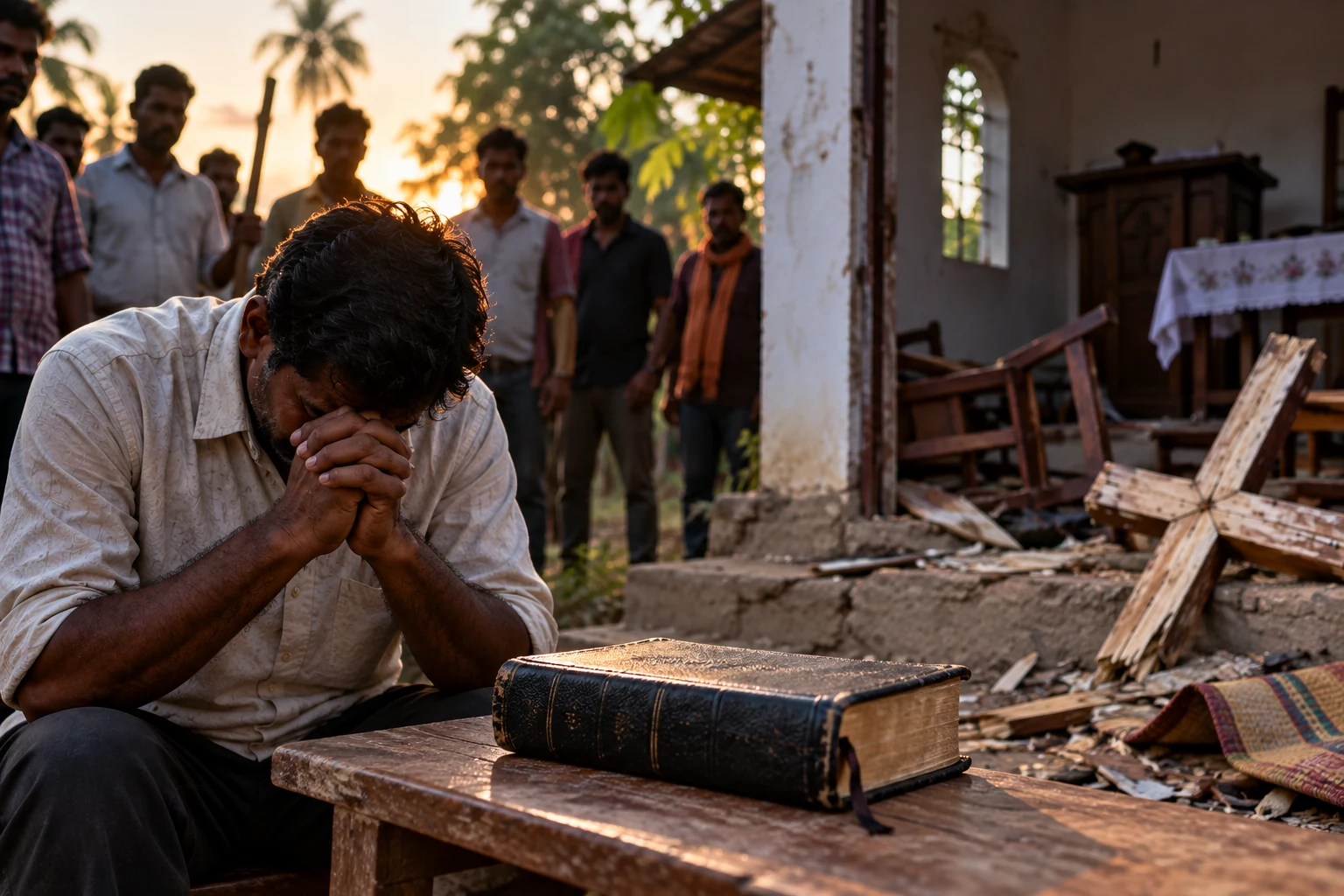
That same Sunday morning, in Rangilabasan village in East Medinipur, around 125 people reportedly entered a house being used as a temporary Presbyterian church.
Most worshippers had already left after the morning service.
According to church member Chhabi Das, the property was vandalised and a Christian cross was broken into four pieces.
Tapan Samanta, whose home was being used for worship, was allegedly assaulted.
Women from the church who heard the disturbance reportedly went to the house and attempted to intervene.
Samanta and some of the women were then taken to a local police station before later being released.
Christian leaders have called for a prompt and impartial investigation into both incidents.
Christians have already been stopping their prayer meetings
These events come against a broader and increasingly troubling background in West Bengal.
The Indian Express reported earlier this month that Christian groups in several districts had suspended house prayers and pastoral visits following a series of attacks.
On 23 August, around 60 Christians were reportedly gathered for Sunday prayers in a rented house in Uluberia when a mob entered accusing them of forced conversions.
Pastor Mithun Hazra said men and women were assaulted and furniture, a sound system, podium and fans were damaged.
Police rescued members of the congregation and took them to hospital.
An FIR was subsequently registered.
Another prayer gathering was reportedly attacked in Howrah on 25 August.
The following day, a pastor and his wife at another house prayer meeting in Purba Medinipur were allegedly beaten and taken to a police station.
There have also been disputes surrounding a Christian burial and vandalism at a church under construction.
The cumulative effect matters.
A prayer meeting abandoned through fear is still a loss of religious freedom.
What about allegations of forced conversion?
This issue needs to be treated carefully.
Some Hindu organisations have accused Christian groups of coercive conversion or offering money to induce people to change religion.
Those allegations should not simply be dismissed because Christians are making the opposing claim.
If anybody is genuinely using threats, fraud or coercion to force another person to adopt a religion, authorities should investigate and prosecute any offence established by law.
Christianity itself provides no justification for forced conversion.
Faith compelled by violence is not faith.
But exactly the same principle works in the opposite direction.
An allegation of improper conversion does not give a crowd the right to invade a prayer meeting.
It does not give anybody the right to beat worshippers.
It does not permit the destruction of Christian property.
And it certainly does not justify forcing a pastor to promise that he will stop preaching.
Complaints belong with lawful authorities.
Religious coercion cannot legitimately be answered with more religious coercion.
The freedom to choose Christ
There is a deeper issue beneath these disputes.
Religious freedom cannot mean merely allowing people to remain within the religion into which they were born.
It must include the freedom to change one’s beliefs.
A Hindu must be free to become a Christian.
A Christian must be free to become a Hindu.
A Muslim must be free to become an atheist.
And an atheist must be free to become a Christian.
Otherwise what is being protected is not freedom of religion.
It is inherited religious identity enforced by social pressure.
For Christians, evangelism is an unavoidable part of the faith.
Jesus commanded His followers:
“Go ye into all the world, and preach the gospel to every creature.” – Mark 16:15 (KJV)
Christians cannot obey that command by forcing anybody to believe.
But neither can they obey it if they are forbidden from speaking about Christ.
The distinction between persuasion and coercion is therefore essential.
A person must remain free to hear the Gospel, reject it, accept it, leave Christianity later, or never engage with it at all.
The state should protect that freedom equally.
A government cannot outsource religious control to the crowd
West Bengal’s authorities have said that prayer is a matter of personal religious choice and that allegations of forced conversion should be dealt with according to law.
That principle needs enforcement.
If Christians are breaking the law, investigate them.
If their accusers are breaking the law, investigate them too.
What cannot become acceptable is an unofficial system in which groups of citizens decide which prayer meetings may take place and which pastors may preach.
The rule of law exists precisely to prevent that.
No religious majority should possess an informal veto over the peaceful worship of a minority.
Pray for Pastor Singh and India’s Christians
Pastor Sukhendu Singh’s case now deserves a proper investigation.
If he was beaten and forced to renounce his ministry as alleged, those responsible should be held accountable.
The written undertaking reportedly extracted from him under duress should carry no moral authority over his Christian ministry.
Christians should pray for Singh, his congregation and the eight Christian families gathered for worship that Sunday.
Pray also for Tapan Samanta and the Christians whose house church was reportedly attacked the same morning.
Pray for India’s authorities, that they will defend genuine religious freedom without favour.
And pray for those hostile to Christianity.
The Christian response to persecution is not hatred.
It is to continue proclaiming Christ.
Because nobody should be forced to become a Christian.
And nobody should be forced to stop being one.
Sources
Join the God Wins Newsletter
Christian news, commentary and Gospel outreach delivered directly to your inbox.