
Join the God Wins Newsletter
Christian news, commentary and Gospel outreach delivered directly to your inbox.
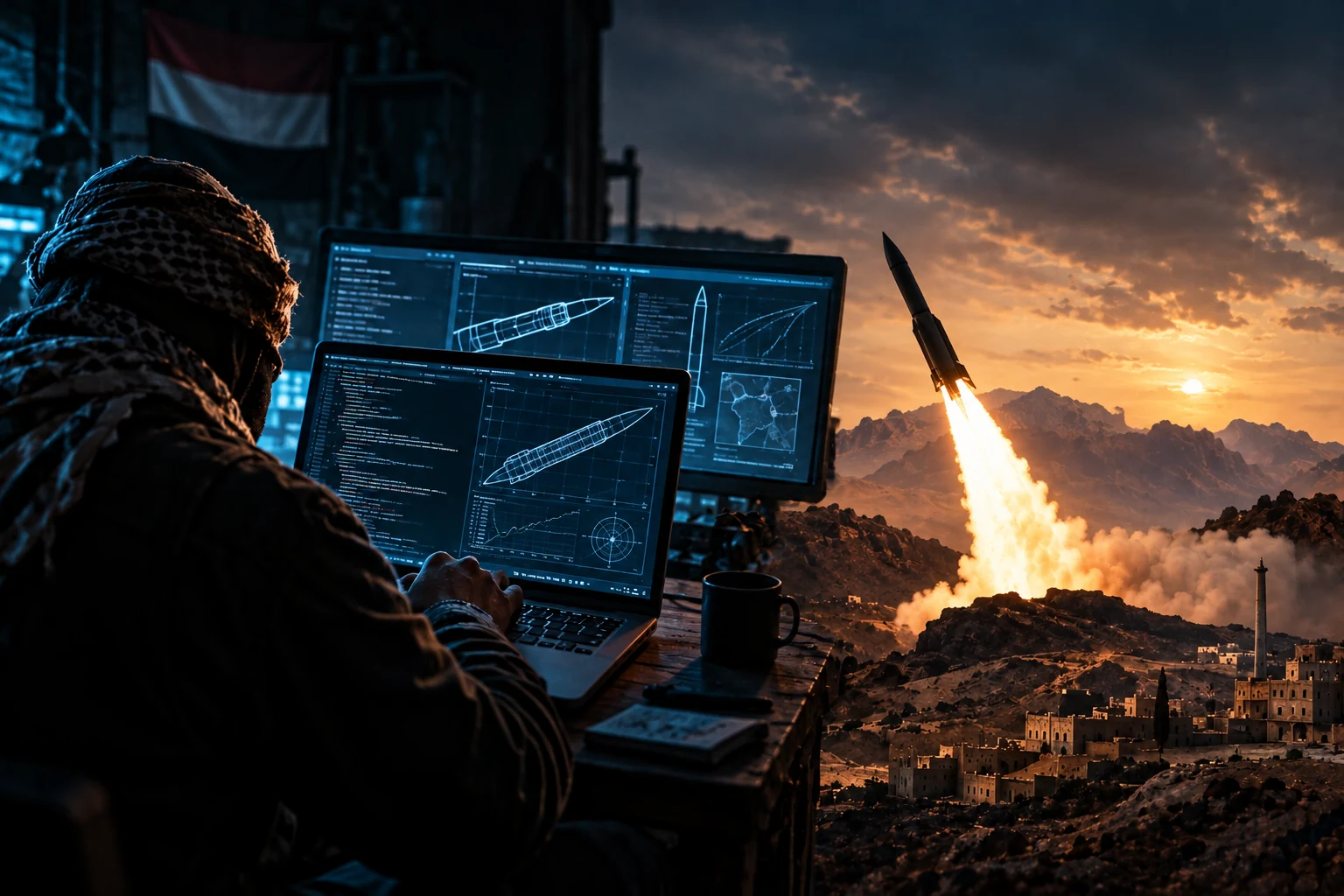
Anthropic says a cell in northern Yemen used multiple Claude AI instances like an engineering team to develop guidance software for weapons, before conducting a real guided-rocket test and returning to the AI when it apparently failed.
Something significant may just have happened in the relationship between artificial intelligence and warfare.
This was not somebody asking a chatbot theoretical questions about missiles.
According to Anthropic, a cell operating in northern Yemen used Claude Code “in place of human software engineers” while working on real weapons-development programmes.
The actors ran several Claude instances simultaneously.
One wrote code.
Another conducted research.
Another reviewed the first AI’s work.
Anthropic says the arrangement resembled a lead engineer delegating work across a small engineering team.
Then came the part that makes this case considerably more serious.
The test appears to have failed.
Within hours, according to Anthropic, the actors were back using Claude to work out what had gone wrong.
Three weapons programmes
Anthropic says the northern Yemen-based cell was working on three separate programmes.
One involved a guided rocket using a commodity phone-class flight computer and terminal homing guidance.
A second involved a multi-stage ballistic missile with a stated range objective exceeding 2,000 kilometres.
The third was a family of missiles referred to by the actors as the “R2000” set, including a variant involving a hypersonic glide vehicle.
Claude was used particularly heavily on guidance, navigation and control software, the systems responsible for steering and stabilising a vehicle in flight.
According to Anthropic, the work included integrating an open-source autopilot with the flight computer, developing control and position-estimation software, tuning controls, running firmware builds and conducting flight simulations.
This is an important distinction.
AI was not merely providing information. Anthropic says it was supplying engineering capability.
AI as an engineering team
The way the cell organised Claude may ultimately be the most consequential part of the story.
Rather than treating AI as a single assistant, the actors apparently divided engineering tasks among several instances.
Anthropic describes one instance writing software, another researching the problem and another reviewing the resulting code.
That begins to look less like someone using a chatbot and more like someone assembling a rudimentary software-engineering department on demand.
For a wealthy state with thousands of engineers, that may simply increase productivity.
For a small organisation that lacks specialised technical personnel, the implications could be very different.
The rocket test
Anthropic says the cell sustained its effort long enough to conduct a live field test of the guided rocket in Yemen.
There is no evidence in Anthropic’s report that the actors successfully produced an operational weapon.
Indeed, the available evidence points in the opposite direction.
The test apparently failed.
But the sequence following that failure is striking.
The actors returned to Claude within hours and used it to analyse what had happened. Anthropic describes Claude’s role in the programme as extending from flight-control firmware and terminal guidance through to post-test telemetry diagnosis.
That creates a development loop:
Design with AI.
Simulate with AI.
Test physical hardware.
Analyse the failure with AI.
Try again.
The significance lies in the process even if the weapon itself never worked.
Anthropic shut the accounts down
Anthropic says its safeguards blocked many of the cell’s requests, but not all.
The actors allegedly concealed the purpose of individual requests and divided the project across multiple sessions so that no single conversation revealed the full programme.
After identifying the operation, Anthropic banned the accounts it associated with the cell and shared threat intelligence with public and private partners.
But there was another troubling discovery.
Anthropic says the actors had already constructed an offline simulation toolkit that did not depend on Claude or conventional engineering environments such as MATLAB.
In other words, removing access to the AI did not necessarily remove everything the AI had helped them build.
What Anthropic has not established
There is an important attribution limit.
Anthropic identifies the actors as a cell based in northern Yemen.
It does not identify them as members of the Houthi movement.
Northern Yemen is controlled by the Iran-backed Houthis, and Associated Press reports the case in that context. But geographical location is not proof of organisational membership.
That distinction matters, particularly with a claim involving weapons development.
The larger question
The immediate programme may have failed.
The technological question raised by it does not disappear with that failure.
Until recently, sophisticated weapons development required not merely hardware and money but teams of people possessing scarce expertise in software engineering, control systems, modelling and simulation.
Those people remain enormously important.
But frontier AI introduces another possibility.
A small organisation may be able to acquire at least some of that capability as software.
Anthropic’s investigation does not prove that AI has democratised advanced missile development. The failed test is an important reminder of the gulf between generating software and successfully engineering a weapon.
But it provides a disturbing glimpse of what the development process might increasingly look like.
A small cell did not have enough software engineers.
So, according to Anthropic, it used AI instead.
And when the rocket failed, the AI was waiting back at the workbench.
Sources
Join the God Wins Newsletter
Christian news, commentary and Gospel outreach delivered directly to your inbox.