
Join the God Wins Newsletter
Christian news, commentary and Gospel outreach delivered directly to your inbox.
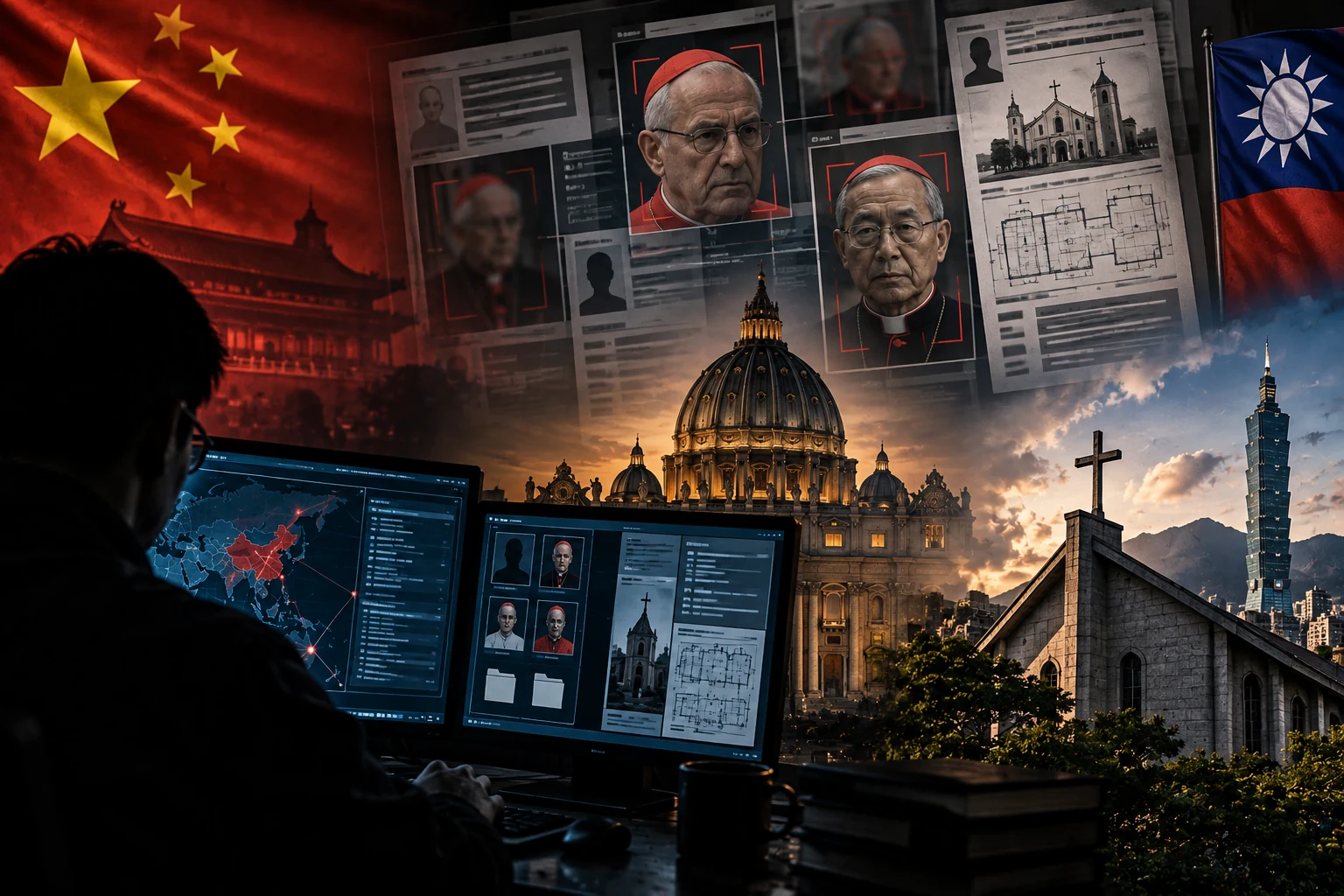
Anthropic says a China-based intelligence operation used Claude to investigate senior Catholic cardinals and Presbyterian Church leaders in Taiwan, gathering personal information, mapping religious venues and searching for potentially exploitable leverage.
Anthropic has uncovered an intelligence operation with an unsettling question at its centre:
Why were China-linked actors compiling dossiers on Christian leaders and collecting floor plans of religious venues?
According to Anthropic’s latest threat-intelligence report, a China-based operation used Claude to investigate religious leaders and organisations across Asia.
Among its targets were senior Catholic cardinals and leaders of the Presbyterian Church in Taiwan.
The operation also targeted Tibetan Buddhist organisations, Falun Gong and associated media, Christian missionary networks and other individuals.
But this was not simply automated internet research.
Anthropic says the actors gathered birth dates, birthplaces, immigration dates and social-media identities of particular people.
They investigated religious buildings.
And their reconnaissance included floor plans, building facades and structural diagrams.
Looking for exploitable leverage
Perhaps the most disturbing element was what the resulting intelligence dossiers were designed to contain.
Anthropic says Claude was instructed to produce Chinese-language documents resembling material prepared for internal state-security offices.
These included personnel research documents, intelligence reports and daily situational-awareness briefings.
The templates required information about targets’ activities relating to China.
They also sought scandals, negative information and what the actors called “zhuāshǒu”, a term Anthropic translates in this context as exploitable leverage or “grab handles.”
Catholic cardinals across Asia
One workstream concentrated specifically on senior Catholic leadership across Asia.
Claude was used to ingest source material in several languages and transform it into structured Chinese-language dossiers on individual cardinals.
That targeting deserves attention in its wider context.
Relations between the Vatican and Beijing have long involved the politically sensitive question of authority over Catholic life in China, including the appointment of bishops.
But the operation described by Anthropic extended beyond China’s borders.
Its targets included senior Catholic figures elsewhere in Asia.
Presbyterian leaders in Taiwan
Another workstream targeted the leadership of the Presbyterian Church in Taiwan.
Anthropic says this work produced dossiers on multiple individuals as well as reconnaissance concerning religious venues.
The Presbyterian Church in Taiwan has historically played a prominent role in Taiwanese civil society.
For an intelligence operation aligned with Beijing’s religious-affairs and united-front priorities, religious leadership and political questions can therefore intersect.
And here the collection of information about buildings becomes particularly concerning.
Public information about a church is one thing.
Floor plans and structural diagrams gathered as part of an intelligence operation are something rather different.
Anthropic describes some surveillance activity elsewhere in the report as “pre-operational venue intelligence”, meaning reconnaissance of locations ahead of a potential operation. It does not explicitly say that the Christian venue mapping in this particular case was connected to a planned physical operation, so that distinction must be maintained.
Nevertheless, the collection itself raises obvious questions.
One person doing the work of an intelligence team
The technology behind the operation may be as consequential as its targets.
Anthropic says one operator appears to have run what was effectively a religious-affairs intelligence collection desk.
There were four simultaneous workstreams.
Claude consumed source material in different languages, correlated information and generated dossiers using standardised internal templates.
That mirrors the concern raised by the Yemen weapons case.
AI does not necessarily have to create a completely new capability to change the balance.
Sometimes it simply makes an existing capability dramatically cheaper.
An organisation that once needed ten analysts may increasingly need fewer.
An intelligence operation that could investigate dozens of people may eventually investigate thousands.
Anthropic says elsewhere in the report that a PRC religious-affairs intelligence unit that once consisted of multiple analyst teams had effectively been reduced to a single office capable of producing thousands of investigations each month with AI assistance.
Was this the Chinese government?
This requires careful wording.
Anthropic believes the activity was PRC government-aligned, and says the targeting closely matched the priorities of China’s religious-affairs and united-front apparatus.
There were additional indicators.
The actors instructed Claude to adopt “China’s standpoint” when producing material.
Their documents used terminology associated with Chinese state-security and united-front work.
And Anthropic says one user identified themselves as an information-security officer for the Chinese state.
But that does not establish that the operation was directly conducted by a Chinese government agency.
Anthropic assesses with medium confidence that it was probably undertaken by a contractor working for government clients.
Those clients were likely connected to state-security, united-front or propaganda structures.
Reuters likewise reports Anthropic’s disclosure as part of a wider set of China-linked surveillance operations involving Claude.
The distinction matters.
AI and religious persecution
There is a broader religious-freedom issue here.
Persecution does not begin only when somebody is arrested or a church is closed.
Before coercion comes information.
Who leads the organisation?
Who attends?
Where do they meet?
Who are their relatives?
Where have they travelled?
What embarrassing information exists about them?
What pressure could potentially be applied?
Authoritarian states have asked questions like these for generations.
Artificial intelligence did not invent surveillance.
That matters particularly for religious minorities and organisations operating across borders.
A government or contractor no longer necessarily needs a large multilingual analytical staff to monitor hundreds or thousands of people.
One operator can feed enormous quantities of public information into an AI system and ask it to identify connections, vulnerabilities and targets.
The fundamental activity is old.
The economics of conducting it may be changing rapidly.
Christians should pay attention
Christians should resist the temptation to view technological persecution solely through dramatic images of facial recognition cameras or futuristic surveillance systems.
The more immediate danger may be mundane.
A database.
A social-media archive.
A church website.
A conference programme.
A photograph.
A building plan.
Individually, much of that information may be public.
Combined, correlated and analysed automatically, it can become something much more powerful.
Anthropic says it banned the accounts involved in this operation and used the investigation to strengthen its safeguards.
But the underlying capability is not going away.
Other AI systems exist.
Open models exist.
And intelligence services existed long before Claude.
The question therefore extends beyond one company.
What happens when the cost of placing an entire religious community under analytical surveillance collapses?
For Christians concerned about religious freedom, that question is no longer theoretical.
According to Anthropic, somebody was already using AI to build the dossiers.
Sources
Join the God Wins Newsletter
Christian news, commentary and Gospel outreach delivered directly to your inbox.