Join the God Wins Newsletter
Christian news, commentary and Gospel outreach delivered directly to your inbox.
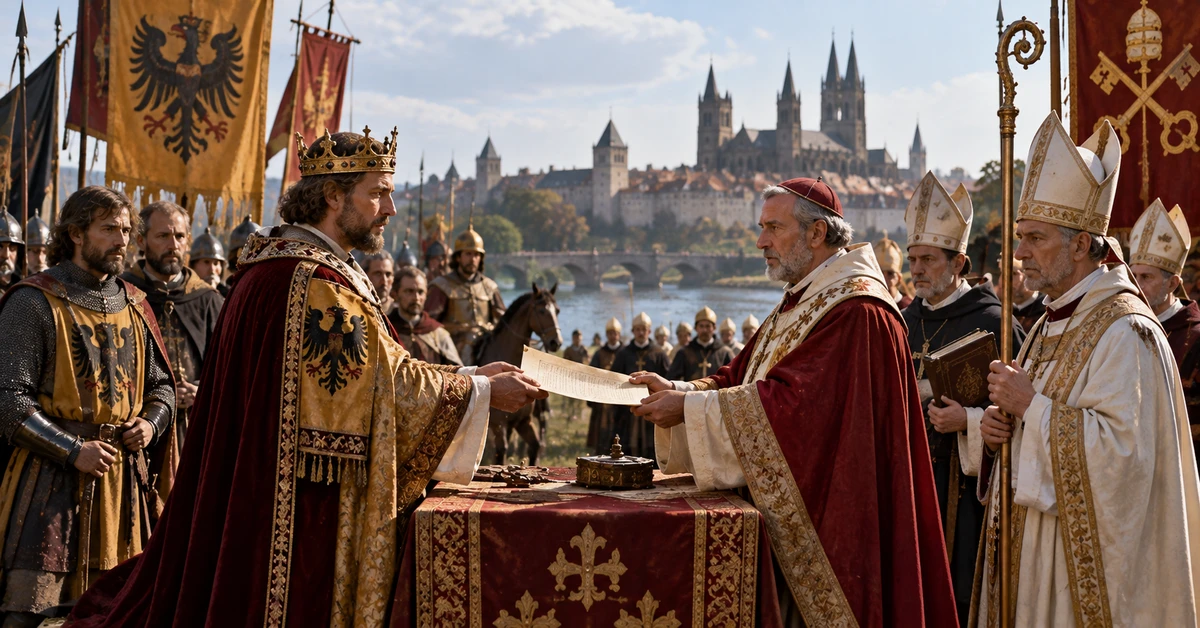
On 23 September 1122, representatives of Pope Callixtus II and Holy Roman Emperor Henry V concluded the Concordat of Worms, bringing the main phase of a decades-long struggle over who held the authority to appoint bishops and abbots to an end.
The dispute, known as the Investiture Controversy, had placed popes and emperors in conflict over the relationship between spiritual and secular authority.
At its heart was the question of who could invest bishops with their office.
The issue carried enormous political consequences. Medieval bishops were not solely spiritual leaders. Many also controlled land, wealth and political territories, making their appointment important to both the Church and secular rulers.
For emperors, influence over episcopal appointments provided considerable political power.
For the Church, allowing secular rulers to confer the symbols of spiritual office raised a fundamental question about who possessed authority over its leadership.
The Concordat of Worms attempted to resolve the conflict by distinguishing more clearly between the spiritual and temporal aspects of episcopal office.
Under the settlement, Henry V renounced the practice of investing bishops with the ring and staff, symbols associated with their spiritual authority.
He also accepted the principle of canonical election and consecration.
The papal side, meanwhile, recognised that the emperor would continue to have a role concerning the temporal rights and responsibilities attached to episcopal office.
The agreement therefore did not completely separate Church and political authority.
Nor did it establish religious liberty or separation of church and state in the modern sense.
Instead, it placed a clearer boundary around the ability of a secular ruler to confer spiritual authority upon the leaders of the Church.
The settlement brought the central phase of the Investiture Controversy to an end after decades of confrontation between the papacy and the Holy Roman emperors.
The surviving papal and imperial documents recording the settlement are dated 23 September 1122 and preserve the commitments made by both sides.
More than 900 years later, the dispute behind the Concordat remains recognisable.
Christians have repeatedly faced the question of how the Church should exist within political society while retaining authority over its own spiritual leadership.
The Concordat of Worms did not provide the modern answer to that question.
But on 23 September 1122, Church and imperial authorities agreed that the emperor should no longer simply confer the symbols of spiritual office upon bishops.
It was an important moment in the long history of defining where political authority ends and the spiritual authority of the Church begins.
Sources
- Yale Law School, Avalon Project — Concordat of Worms, 1122
- The Times — historical anniversary summary
- Christianity Today — Today in Christian History: 23 September
Join the God Wins Newsletter
Christian news, commentary and Gospel outreach delivered directly to your inbox.