
Join the God Wins Newsletter
Christian news, commentary and Gospel outreach delivered directly to your inbox.
Archaeological research beneath Jerusalem’s Church of the Holy Sepulchre has revealed evidence of an ancient landscape containing cultivated ground alongside rock-cut tombs, offering a striking parallel with the setting described in the Gospel of John.
The findings form part of the Hagia Polis Project, a major archaeological investigation carried out during restoration work inside one of Christianity’s most important holy sites.
Excavations began in 2022 and concluded in October 2025, although researchers are continuing to study the materials, documentation and archaeological evidence recovered from the site. The project’s first major volume was presented at Sapienza University of Rome on 17 September 2026.
The research has allowed archaeologists to reconstruct parts of the landscape that existed before the construction of the church.
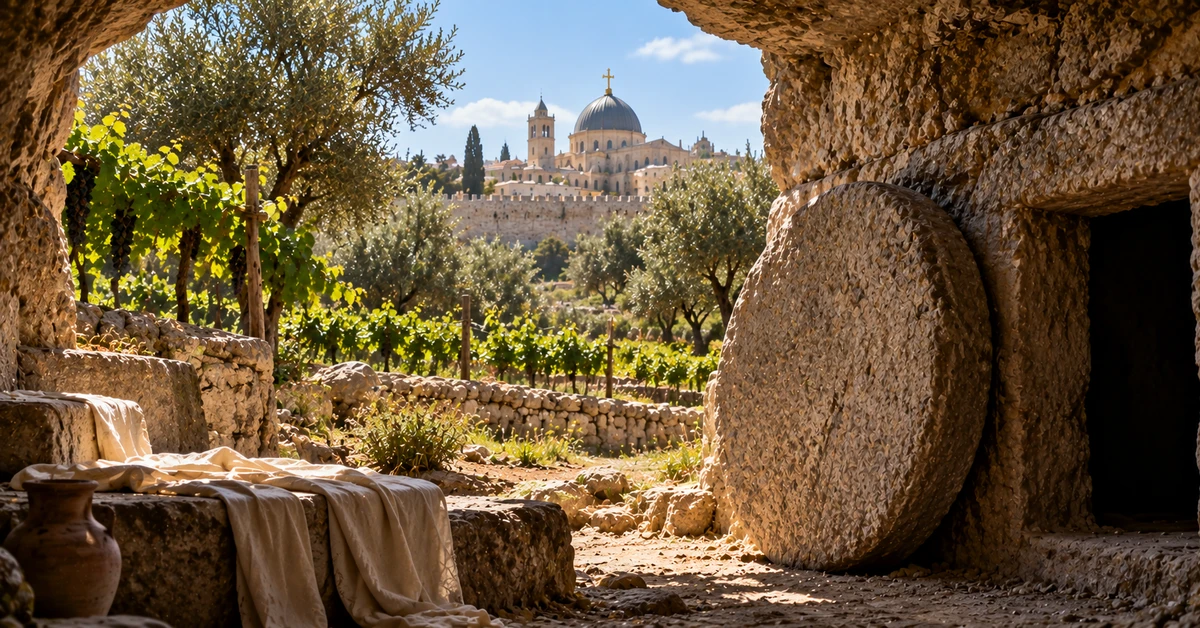
The area had originally been used as a stone quarry. After quarrying ceased, sections were filled with soil and divided by low dry-stone walls, creating small areas suitable for cultivation.
Archaeobotanical analysis identified evidence including cereals, grapes, figs and grasses. Researchers also found vine wood, while pollen analysis indicated the possible cultivation of olive trees.
Alongside these cultivated areas were rock-cut tombs.
Professor Francesca Romana Stasolla, who directed the excavations, described the evidence as showing a funerary landscape alongside small areas planted with vines and olive trees.
The combination is significant because of the description of Jesus’ burial found in the Gospel of John.
John 19:41 records that there was a garden at the place where Jesus was crucified and that within the garden was a new tomb in which nobody had yet been buried.
The archaeological findings do not prove that Jesus was buried at the site now occupied by the Church of the Holy Sepulchre, and the researchers have not claimed that they do.
Nor can researchers currently establish that the cultivated areas were being used at the precise time of the crucifixion.
The agricultural landscape has been dated broadly to a period encompassing the lifetime of Jesus, between the abandonment of quarrying and the redevelopment of the area under Emperor Hadrian in the second century. Direct radiocarbon dating of the plant remains has not established a more precise date.
What the archaeology does establish is that the ancient landscape beneath the traditional site included features consistent with important elements of John’s account: cultivated ground and nearby rock-cut tombs.
The Holy Sepulchre has been associated with the crucifixion and burial of Jesus since antiquity. The present church developed from the complex constructed under Emperor Constantine in the fourth century.
The latest excavations are providing researchers with a much longer archaeological history of the location, extending from its early use as a quarry through its funerary and agricultural phases and into the successive structures built above it.
More than 40 scholars contributed to the first volume of the Hagia Polis Project. Further publications are planned as analysis of the excavation continues.
For Christians, the discovery is noteworthy without requiring archaeology to prove the Gospel account.
Beneath the traditional site of Jesus’ burial, archaeologists have found an ancient landscape containing both cultivated ground and tombs.
Nearly 2,000 years ago, John described a garden and a nearby tomb.
Sources
- Vatican News — Hagia Polis Project
- Vatican News — The Anastasis, an empty tomb and a garden in bloom
- Christian Daily International
Join the God Wins Newsletter
Christian news, commentary and Gospel outreach delivered directly to your inbox.